Anya Schiffrin on the Historic Eight Year Run of PM Newspaper
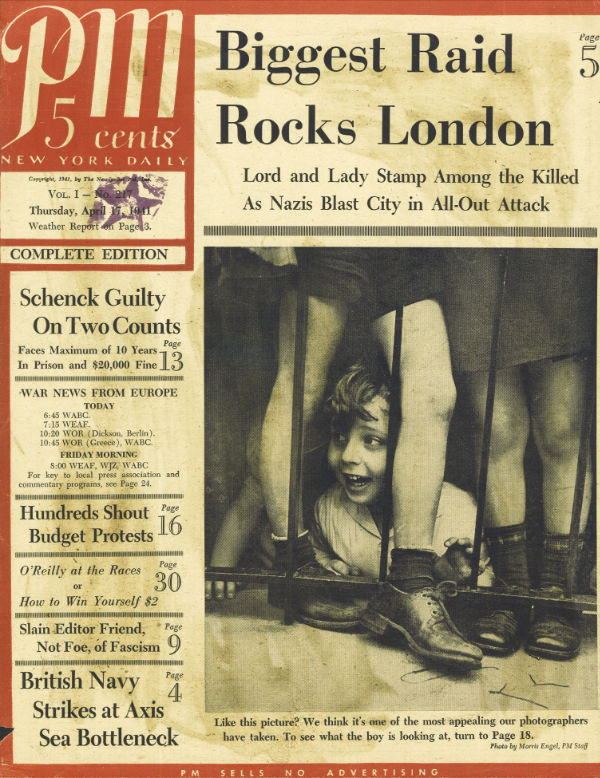
Back in 1940, a journalist by the name of Ralph Ingersoll started a newspaper called PM. It was a daily newspaper. It carried no ads. It had a circulation of 150,000. It was in constant battle with the corporate right. It was published from 1940 to 1948.
“PM was a dream about pure journalism, and a dream is always important, whether or not it succeeds,” Heywood Hale Broun, a sports writer at PM told Vanity Fair’s David Margolick. “What the hell, they hung John Brown, but they’re still singing about him.”
PM was staffed by young journalists and artists – the likes of James Thurber, I. F. Stone, Theodor Geisel (Dr. Seuss), Ernest Hemingway, Dorothy Parker, and the photographer Arthur Fellig (Wegee).
The paper was funded by Marshall Field – who reportedly put in $7 million to keep it alive for the eight years it was being printed.
Politics in America today are in turmoil. At the same time, people are getting fed up with the machine and looking for a less distracting, more peaceful way to pick up the news of the day.
Very few people today have ever heard of PM and the role it played in the New Deal politics of the 1940s.
But when we sent out a promotion for the Capitol Hill Citizen – our aspiration is to make it into the Daily Citizen – an avid reader wrote back to tell us about an undergraduate dissertation (Reed College 1984) written by Anya Schiffrin.
The title of the thesis was – We Are Against People Who Push Other People Around – A Study of the Newspaper PM.
She concludes her thesis with this: “Although PM was deficient in many ways, its collapse is worthy of study as an example of the failure of the American left to gain widespread political support. Ralph Ingersoll founded PM because he conceived of a paper that would attack fascism abroad and at home.”
“PM believed that a post-war movement to the left was inevitable and could be brought about, in part, by committed journalists who, free from the pressures of advertisers and big business, would expose injustice and discrimination.”
“In addition, PM was to inaugurate a new journalistic form which would borrow from the news magazine format and use photographs to render news coverage accessible to PM readers. The idea failed for a number of reasons. PM was more expensive than other newspapers, badly distributed, lacked consistent strong management and was stigmatized by accusations of Communist infiltration.”
Schiffrin now teaches at Columbia University’s School of International and Public Affairs in New York City. We interviewed Schiffrin on December 31, 2025. (This interview appeared in the February/March 2026 edition of the Capitol Hill Citizen.
CAPITOL HILL CITIZEN: How did you end up writing your Reed College thesis on PM newspaper?
SCHIFFRIN: My advisor at Reed College, the historian Richard Fox, suggested to me that I research PM. I had always been interested in journalism. After I graduated from Reed, I worked as an intern at the Nation magazine. I then went overseas and became a freelance journalist.
CHC: I find that most citizen activists I speak with have never heard of PM. Do you find that to be true?
SCHIFFRIN: Absolutely. But when Richard Fox pointed me to PM, I realized it was a brilliant idea. Nobody had written much about it. My undergraduate thesis was basically a book on the topic. Nobody else had done that. There were a few memoirs by people who had worked at PM and they were writing about parts of their life. I spent many happy hours with my dad at the New York Historical Society and read back issues on microfilm.
And there were still some PM staffers, people like Blair Clark, who were still alive that I was able to interview. And then later, Paul Milkman wrote a history of PM called PM: A New Deal in Journalism. (Rutgers University Press, 1997)
CHC: And there is the great biography of Ralph Ingersoll by Roy Hoopes (Athenneum, 1985).
SCHIFFRIN: Yes. Many of the staff associated with the PM newspaper ended up being blacklisted. And when James Weschler started testifying before the House You would love the photos in this PM newspaper.
One of them had pictures of the night that FDR won election for the third time. PM sent Weegee around the city to take photographs. He took photographs on the Lower East Side of everybody rejoicing. And then he went uptown to the Waldorf or some place like that and took pictures of all the rich people being sad Un-American Activities Committee, he called PM “a communist front.”
One of my research questions was to see whether or not that was true. And I came to the conclusion that it was not true. Obviously, there were battles with Communists in the newspaper guild, and some people who worked there were members of the party.
This was similar to the group that I later studied – that did media literacy. Many of these groups were accused of being communist fronts when they probably were not. I concluded that PM was not a communist front. But there was a stigma because of the hearings and the accusations and perhaps that stigma was part of the reason it has been forgotten. But in general, people do forget history.
Much of my work has been unearthing older forms of journalism that people have forgotten about. PM was a relic of the popular front era. The slogan was – we are against people who push other people around. The idea was that it was going to be a paper for the working man, not take advertisements, it was not to be beholden to advertisers, and it would provide news that the common man would be interested in. The style of the newspaper was folksy.
It was a little bit of talking down to the common man. The founder of PM, Ralph Ingersoll, was a member of New York’s elite.
But the paper was also part of the popular front era, where people were going to rallies to fight fascism at home and abroad. It was a very inspiring publication.
Later on, I started doing some work on Clyde Miller and the Media Literacy Movement of the 1930s. It was part of that John Dewey idealism – if we can get labor unions and consumer unions engaged, we can build a better democracy in our country? It was inspiring.
CHC: Has there been anything like PM before or since?
SCHIFFRIN: Well, now of course we have a huge renaissance of non-profit news.
CHC: I’m thinking about a print daily populist newspaper without ads.
SCHIFFRIN: I’m not sure of that, but we have a whole movement now for local news funded by philanthropists and readers rather than by advertisers. You have a lot of groups trying to do that work now. There is constant experimentation right now to build alternative voices, especially with corporate media becoming so captured – Jeff Bezos talking over the Washington Post, what’s happening in Chicago and Los Angeles.
And so yes, I see a huge attempt across the country to replicate some aspect of the PM idea. This model of trying to escape corporate domination is part of the American tradition. And of course in Europe you have things like worker owned cooperatives. PM was not a cooperative. And it lost money.
CHC: When you were doing your research on PM, how did it strike you as being different from the newspapers of the day?
SCHIFFRIN: There was more of an emphasis on the working man. They tried to write articles that they thought the working man would be interested in. They didn’t always hit the mark. I remember reading articles on how to make a thrifty meal and what was happening with the labor movement. They would write about social justice in a way that was accessible.
CHC: There was a 1999 Vanity Fair article about the newspaper. There was a sports reporter for PM. His name was Heywood Hale Broun. And the reporter for Vanity Fair, David Margolick, went to interview Broun. And Broun told him this – “PM was a dream about pure journalism, and a dream is always important, whether or not it succeeds. What the hell, they hung John Brown, but they’re still singing about him.”
The paper did fail after eight years. It ran from 1940 to 1948. Marshlal Field kept it going with a reported $7 million over those eight years. It had all of these names that went on to become superstars in American culture, including PM’s cartoonist, Dr. Seuss.
SCHIFFRIN: After Marshall Field got out, Bartley Crum took over. And Crum’s daughter, Patricia Bosworth – she and I stayed in touch. They cherished that newspaper. She became a writer in her own right.
CHC: You are now a professor at Columbia. What do you teach there?
SCHIFFRIN: I teach global media and I teach myths and disinformation. I supervise some of the PhD students in the journalism program.
CHC: We are looking at professors being fed up with AI doing the work for students and moving toward oral exams instead of written exams to overcome cheating by students. We are hearing from our readers that they enjoy holding the paper in their hands and getting away from the distractions of the internet, even if it’s only for a few minutes.
What are the possibilities of the emergence of a new PM?
SCHIFFRIN: First, my students make robust use of AI. And as a result we are doing a lot more oral presentations and in class writing assignments so they can stay in touch with their own ability to write, present and absorb. You want them to keep those skills sharp. There is a paradox.
While everyone is on their phones looking at AI generated content, there is a need for authenticity and a desire for it. It may be for a minority. It may be for a minority of educated people. But the demand for print will continue. And there will be some survivors. And the survivors will be publications like the New York Times and the Guardian and some of the niche print newspapers.
I’m thinking of papers like the Daily Maverick in South Africa, which started a print edition a few years ago and had to get rid of it because it was just too expensive. I profiled the Daily Maverick for the Columbia Journalism Review a few years ago. They write great stories on labor, public corruption, water shortages. It’s very popular in South Africa among the educated online public.
The economics of print can be tough. But the rewards for the reader are enormous.
CHC: Our dream is to bring back the PM type of newspaper. What are the chances, given the current political turbulence, that we could break out into a new populist moment in America?
SCHIFFRIN: My students are very international. I’m at the School of International Affairs. And they are absolutely passionate about world events and world affairs. They tend to read much more online than print. One of the reasons I enjoy teaching about journalism in an international school is because it opens them up to a whole new world that they didn’t know about. They will be very excited to learn about something like PM because this would not have been part of their upbringing. I would say they are firmly online, but very interested in experimentation, in new ideas and in alternative news sources. The number of outlets and the things they look at online is extraordinary.
One of the most interesting parts of our class discussion is hearing what they are reading. There is a website that gives both sides of the news – something from the left then something from the right. They are always interested in those types of new ideas.
CHC: Our readers probably don’t know much about your father – Andre Schiffrin. Could you fill our readers in on Andre Schiffrin?
SCHIFFRIN: Absolutely. My grandfather Jacques Schiffrin was a book publisher in Paris. He started what is today the most prestigious collection of books – The Pleiade. It is now published by Gallimard. When the anti-Jewish laws were passed, they fired him right away. He had to serve in the French Army, so he couldn’t get out before the Nazis. But there was an American journalist by the name of Varian Fry who helped many European intellectuals get papers to get to the United States. My dad and grandparents fled on a boat and got to New York in 1941.
My grandfather joined up with a couple – Kurt and Helen Wolff – they were German refugees who were starting a new publishing house called Pantheon. My grandfather died in the 1950s and my father took it over in the early 1960s. And for many years he was a leading progressive publisher. He published books on labor, European fiction, Noam Chomsky, Edward Said, Michel Foucault, Gunnar Myrdal, Eric Hobsbawm, E.P. Thompson – many of the big named progressive thinkers of the time.
Unfortunately, Pantheon was taken over by a large conglomerate – the Newhouse chain – and they pushed him out in the late 1980s. And he started a nonprofit publishing house called The New Press.
So my whole family history has been about corporate capture and then starting something independent. And I’m sure that had something to do with my writing about PM in college. When I started writing it, I didn’t know that my father would be pushed out of his publishing house the way my grandfather was pushed out. But I’m obviously very sympathetic to people trying to start new alternative publishing outlets and present new voices.
CHC: Your father must have been aware of PM during his day.
SCHIFFRIN: Of course he was. That whole generation knew about PM and he was curious to know more about it. We knew people like Victor Navasky and Harry Magdoff – we knew that generation. My dad published the I.F. Stone reader – and I.F. Stone wrote for PM. I grew up with a lot of that. And then later on one of my friend’s father gave me a book by George Seldes, who was a crusading journalist of the day.
When people knew I was writing about PM, they would send me materials and books. In the late pandemic, I got an email from a man who said he was cleaning out his mother’s apartment and he wanted to give me her copies of PM. I was so excited. I wrote back and said – yes of course. I live on the Upper West Side. And she lived in the Upper West Side. So my husband and I ran over there and we got the two copies of the PM newspaper.
She gave me those copies, I framed them and they are hanging up in my apartment now. You would love the photos in this newspaper. One of them had pictures of the night that FDR won election for the third time. PM sent Weegee around the city to take photographs. He took photographs on the Lower East Side of everybody rejoicing. And then he went uptown to the Waldorf or some place like that and took pictures of all the rich people being sad.
CHC: It was a Mamdani moment.
SCHIFFRIN: Exactly.